Signed in as:
filler@godaddy.com
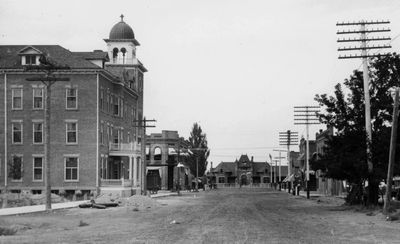
It’s hard to believe that just 141 years ago, the town of Nampa didn’t exist and the landscape was covered in sagebrush and loose dirt. There was no river to feed the parched land, just a few shallow, seasonal creeks. To most, this area looked like a non-productive, useless patch of nothingness.
However, in 1883, this area we call Nampa was chosen to be a stopping point along the Oregon Short Line Railroad. It was just one of many places for passengers and cargo to be loaded and unloaded.
Our earliest Caucasian pioneer was Alexander Duffes and his wife, Hannah. Alexander was the only United States citizen in his family, having been born in Utica, New York shortly after his parents arrived from Scotland. Before long, his father moved the family to Canada where they lived and established themselves in business. Alexander and his father were both carpenters and builders. Alexander also worked as a merchant.
Because of Alexander’s failing health, he sold all his assets and he and his wife sought opportunities first in Montana: too cold. Then they went to British Columbia, then Spokane, Washington and finally to Portland, Oregon. Their landlord’s brother-in-law came to visit after about two years from Caldwell, Idaho. He impressed upon Alexander the wisdom of moving to Idaho, which was opening up to settlement since the Oregon Short Line railroad was now established and invited Alexander to come to Caldwell to visit in 1885.
Instead of settling in Caldwell, Alexander drove around the area for three or four weeks and finally found what he was looking for, a place to establish a new townsite. He purchased 160 acres of land and began building a house at what is now 9th Ave N between 1st and 2nd streets north. This put his new home close to the railroad. This is the home Alexander, Hannah and son Picton lived in for many years. The only other building in “town” was the railroad section house.
No large bodies of water were in Nampa at that time, but it became available in five years when construction on the irrigation canal system began.
By 1887, the Idaho Statesman reported that 45 people had filed on land in the new townsite of Nampa. The parcels were listed at between 80 and 960 acres. Some of the people who proved up on the land were in some way related to the railroad. Those living in the new homes were mostly women and children, as the man of the house had to go elsewhere to work. Since there was no significant amount of water was available, farming was out of the question until irrigation came to be.
Because of his conservative Presbyterian background, Alexander Duffes would not allow any townsites to be used for saloons. For many years, Nampa was a “dry town.”